

Connect for strength
An inclusive city that supports social connections and community agency
Direction 3Communities in Greater Sydney are fatigued by consecutive shocks and ongoing stresses. Mental health was identified through the risk assessment and community engagement as the top stress for people in Greater Sydney. People in Greater Sydney report significant increases in depression, anxiety and other mental health illnesses compared to pre-pandemic levels. Nearly 40% fo young Australians (aged 16 to 24) experienced a mental health disorders between 2020 and 2022, up from 26% in 2007. People in community consultation consultation identified social isolation as undermining their wellbeing. Building connections to place and to each other is more important than ever as this helps to replenish personal and community resilience.
The World Economic Forum identified “erosion of social cohesion and societal polarisation” as the fifth most significant global risk in 2023. In Australia, the Scanlon Social Cohesion report found that “declines in our sense of national pride and belonging, increasing financial strain and a weakening sense of social inclusion and justice were warning signs” for social cohesion. Trust in the decision-making of government is diminishing and is now less than 50% in national surveys. These trends affect our ability to act collectively and make decisions on difficult and complex issues.
Prepared for Emergencies

Social Capital
Consultation and the risk assessment identified that social capital in Greater Sydney is being undermined by inequality, racism, vilification, international conflicts, misinformation, and polarisation. Levels of community connectedness differ across Greater Sydney. Social isolation and lack of strong community connections reduce people’s resilience making them more vulnerable to shock events.

Community Connections
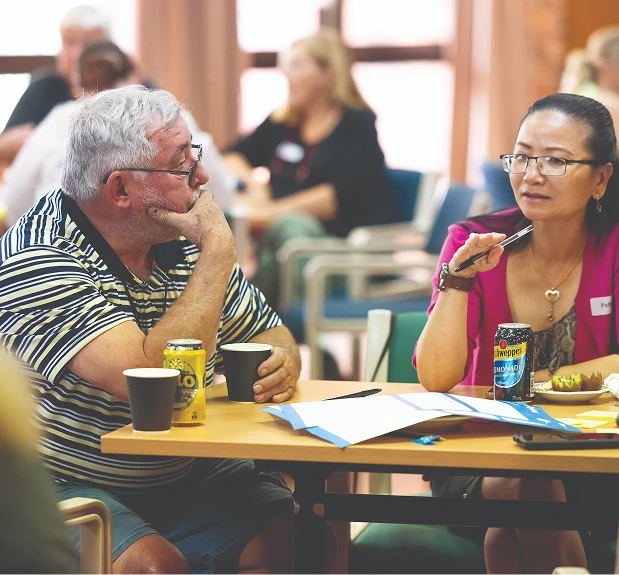
Community consultation identified social isolation as undermining their wellbeing. Building connections to place and to each other is more important than ever as this helps to replenish personal and community resilience.

Building Trust
When people feel that they are seen, heard, understood, included and given the benefit of the doubt they are more likely to trust and feel trusted. Communities that have their voices heard and can influence decisions and hold government to account are more resilient.
The World Economic Forum identified “erosion of social cohesion and societal polarisation” as the fifth most significant global risk in 2023.
Action 14
Embed dignity principles in leadership and engagement
Shocks & stresses
-
 War & conflict
-
 Disease outbreak
-
 Health services
-
 Mental health
-
 Racism & vilification
-
 Family violence
Resilience challenge
Difficult and disrespectful interactions in the delivery of services, and emergency response and recovery environments, harm people’s wellbeing and reduce their resilience. Government policies that are not informed by the people who they affect often violate dignity.
State disaster mitigation plan alignment
- Managed relocations
- Community awareness and preparedness
- Social infrastructure and cohesion
Resilience goals
- The concept of dignity informs the development and implementation of recovery plans and initiatives, helping communities and individuals remain resilient.
- Engagement with communities is genuine, inclusive, safe and fair, and respects historical and local contexts. It informs decision-making to build trust and empower communities.
- People know and respect the history of Sydney and its people.
Action 15
Replenish resilience through creative and cultural expression
Shocks & stresses
-
Disease outbreak
-
 Bushfires
-
 Reducing social cohesion
-
Mental health
-
 Social isolation
-
Racism & vilification
Resilience challenge
Creative and cultural practices support individual and community expression. They provide insight into people’s experiences and perspectives, build social connections and replenish community resilience.
State disaster mitigation plan alignment
- Community awareness and preparedness
- Social infrastructure and cohesion
Resilience goals
- The role of arts and culture in building resilience and recovering from shock events is recognised and resourced by government.
- Creative and cultural practices contribute to a deeper understanding of experiences of shock events and support physical, emotional and mental healing.
- People feel empowered to express diverse experiences through their unique cultures and creativity.
- Strong, connected and sustainable local creative sectors thrive across Greater Sydney.
Action 16
Support First Nations self-determination
Shocks & stresses
-
 Housing stress
-
 Education
-
 Cost of living
-
Mental health
-
 Chronic health conditions
-
Racism & vilification
Resilience challenge
Aboriginal and Torres Strait Islander people in Sydney do not have access to the choices needed to be able to meet their social and economic needs and realise self-determination.
State disaster mitigation plan alignment
- Social infrastructure and cohesion
Resilience goals
- Traditional Custodians, Aboriginal-controlled organisations and community members are included in government decisions that affect First Nations people in Greater Sydney.
- Local councils in Greater Sydney work in culturally informed ways that support increased self-determination for First Nations communities and address entrenched inequality.
Action 17
Facilitate community-led action
Shocks & stresses
-
Bushfires
-
 Flooding
-
Mental health
-
Social isolation
-
 Low trust
-
Reducing social cohesion
Resilience challenge
People in Greater Sydney have experienced the pandemic and other disasters and know that ongoing stresses and future shock events are inevitable. They want governments to support them to build capacity in their local communities to be better prepared and able to respond.
State disaster mitigation plan alignment
- Community awareness and preparedness
- Social infrastructure and cohesion
Resilience goals
- Community voices are integrated into disaster recovery.
- Community members are better informed about their roles and responsibilities in preparing for and recovering from shock events in their local area.
- There are well-connected networks of people with capacity and resources to respond to shock events within their communities.
- Community organisations and businesses have the governance and plans in place to be effective in disaster preparedness and recovery.
Action 18
Engage children and young people in decision-making about the future and their wellbeing
Shocks & stresses
-
Bushfires
-
Flooding
-
Education
-
Mental health
-
Social isolation
-
Low trust
Resilience challenge
Children and young people are experiencing mental health impacts from stresses including climate change, cost-of-living pressures and social isolation. They are also growing up with increasing disruption from extreme weather events. Polarising and desensitising content on social media also has a negative impact. Many young people feel disempowered in the face of global uncertainty.
State disaster mitigation plan alignment
- Community awareness and preparedness
- Social infrastructure and cohesion
Resilience goals
- Greater Sydney is a place where children and young people thrive.
- Children and young people receive the support they need during shock events.
- Young people have the capacity, skills and knowledge to maintain strong mental health and social support networks.
- Young people play an active role in planning for and responding to future shock events.
Action 19
Measure and value social capital
Shocks & stresses
-
 Economic crisis
-
Cost of living
-
Mental health
-
Social isolation
-
Low trust
-
Reducing social cohesion
Resilience challenge
Evidence shows that communities with strong social capital recover from shock events and cope with ongoing stresses better. However, the social infrastructure and local programs that build social capital are often undervalued.
State disaster mitigation plan alignment
- Community awareness and preparedness
- Social infrastructure and cohesion
Resilience goals
- A commitment to building social capital is embedded into government plans and policies.
- Social capital is measured to support investment in social infrastructure.
- Councils and community organisations understand the value of social capital and work together in ways to strengthen it.
Action 20
Facilitate inclusive access to social infrastructure
Shocks & stresses
-
 Heatwaves
-
Cost of living
-
Mental health
-
Social isolation
-
Chronic health conditions
-
Racism & vilification
Resilience challenge
Social infrastructure including community centres, libraries, theatres, parks and playgrounds, sporting and recreation facilities, are not equitably available across Greater Sydney. Social infrastructure is particularly vulnerable to increasing impacts from natural hazards, for example, being flood prone or lacking insulation for heat.
State disaster mitigation plan alignment
- Community awareness and preparedness
- Social infrastructure and cohesion
Resilience goals
- The importance of social infrastructure is recognised in government planning.
- Investment is made in the right social infrastructure as Greater Sydney communities grow.
- People in Greater Sydney have access to community facilities in their neighbourhoods.
- Social and community assets are more climate resilient.